Sauna and heart health: the Finnish studies explained
 By the Find My Sauna team·
Updated ·
7 min read

Most of what you read about saunas and the heart comes from one group of men in eastern Finland. The results are striking, and they're worth understanding properly: who was studied, what was measured, and what the heat actually does to your heart while you sit there.
The short answer
Large Finnish studies link frequent sauna use to fewer deaths from heart disease. Men who used a sauna 4–7 times a week had a 63% lower risk of sudden cardiac death than men who went once a week. In the heat your heart beats faster and your blood vessels widen, and blood pressure tends to be a little lower afterwards. These studies show a link, not proof. If you have a heart condition, ask your cardiologist before you start.
The Kuopio study in brief
The Kuopio Ischaemic Heart Disease Risk Factor Study recruited men aged 42 to 60 from the Kuopio region between 1984 and 1989. Researchers measured their health in detail, asked about their habits, sauna included, and then followed them for decades.
One detail is easy to miss. Every man in the sauna analysis used a sauna at least once a week, because in Finland almost everyone does. So the comparison isn't sauna against no sauna. It's frequent sauna against a weekly one.

What the 2015 paper found
The best-known result appeared in JAMA Internal Medicine in 2015. It covered 2,315 men followed for a median of almost 21 years. After adjusting for blood pressure, cholesterol, smoking and other risk factors, compared with the once-a-week group:
- 2–3 times a week: 22% lower risk of sudden cardiac death and 23% lower risk of dying from coronary heart disease.
- 4–7 times a week: 63% lower risk of sudden cardiac death and 48% lower risk of dying from coronary heart disease.
Session length mattered too. Men whose sessions lasted more than 19 minutes had about half the risk of sudden cardiac death of men who stayed in for less than 11 minutes.
A follow-up in BMC Medicine in 2018 filled one obvious gap. It looked at 1,688 people aged 53 to 74 from the same region, and just over half were women. Again, the more often people used the sauna, the lower their risk of dying from heart and circulation disease.
What happens to your heart in the heat
In a hot sauna, the blood vessels near your skin open wide to get rid of heat. That's why you go pink. To keep blood flowing to your brain and muscles as well as your skin, your heart pumps harder and faster.
The rise is bigger than most people expect. In a 1989 Finnish lab study, eight young men sat in a sauna at 80 °C (176 °F) until they felt uncomfortable. Their heart rate went up by about 60%. At 100 °C (212 °F) it rose by about 90%. That's why sauna researchers often compare a session to light or moderate exercise, though you aren't using your muscles.
After the sauna
What happens afterwards may matter more. In a 2018 study in the Journal of Human Hypertension, 102 adults with at least one heart risk factor spent 30 minutes in a sauna at 73 °C (163 °F). On average:
- systolic blood pressure (the top number) fell from 137 to 130 mmHg, and diastolic (the bottom number) from 82 to 75
- systolic pressure was still lower after 30 minutes of rest
- a measure of artery stiffness, the speed of the pulse wave between neck and groin, dropped from 9.8 to 8.6 metres per second
One theory is that repeating this several times a week keeps arteries more flexible over the years. It's a sensible idea, but it hasn't been proven. Our guide to sauna and blood pressure covers the long-term blood pressure research.

Who the findings apply to
Be careful how far you stretch these results:
- They show links, not cause and effect. Men who used the sauna every day may have been healthier or less stressed to begin with. Adjusting for known risk factors can't rule everything out.
- The people were Finnish and mostly middle-aged men. The 2018 study added women, but we still know little about other countries.
- The saunas were traditional Finnish ones, hot and dry, usually around 80 °C. Nobody knows yet whether an infrared cabin or a steam room does the same. Our guide to infrared saunas explains how different the heat is.
If you already have heart disease
A 2001 review in the American Journal of Medicine concluded that sauna bathing is safe for most people with stable coronary heart disease, including stable angina or an old heart attack. It listed three conditions where you shouldn't use one: unstable angina, a recent heart attack and severe aortic stenosis.
Japan has gone further with a gentle form of heat therapy for heart failure called Waon therapy. Patients sit in a dry infrared sauna at 60 °C (140 °F) for 15 minutes, then rest for 30 minutes wrapped in a blanket. In a 2016 trial across 19 hospitals, 149 patients with advanced heart failure had either daily Waon therapy for 10 days or usual care. The Waon group improved on symptoms, walking distance and heart size on X-ray, though the change in the main blood marker wasn't statistically significant.
Note how mild that is: lower heat, short sessions, in hospital under supervision. It isn't a reason to sit in a public sauna at 90 °C. Ask your cardiologist.
Using the sauna for your heart
- Go regularly. In the studies, how often people went made the clearest difference.
- Keep rounds moderate. 10–20 minutes is normal in Finland. See how long to stay in a sauna.
- Treat the cold with respect. A plunge makes your heart rate and blood pressure jump. If you have heart trouble, a cool shower is the gentler choice. The cold plunge guide explains the cold shock response.
- Keep moving the rest of the week. A sauna isn't a replacement for exercise.
For the wider picture, see sauna benefits.
Who should be careful
- Unstable angina, a recent heart attack or severe aortic stenosis. Don't use a sauna unless your cardiologist says so.
- Any other heart condition, including heart failure and rhythm problems. Ask your doctor first.
- Medicines that lower blood pressure. You're more likely to feel faint when you stand up.
- Medicine patches. Heat can speed up how fast a drug passes through the skin. Ask your pharmacist before you go in wearing one.
- Alcohol. Never combine the two. Drinking in the sauna raises the risk of low blood pressure, an irregular heartbeat and sudden death.
Leave straight away if you get chest pain, palpitations, dizziness or breathlessness.
This guide is general information, not medical advice.
Where to find a traditional sauna
Find My Sauna lists 2,616 places with a Finnish-style sauna, the kind used in the research. These cities have the most:

Rantalan Sauna
Tampere · Finnish sauna

Kotiharjun sauna
Helsinki · Finnish sauna
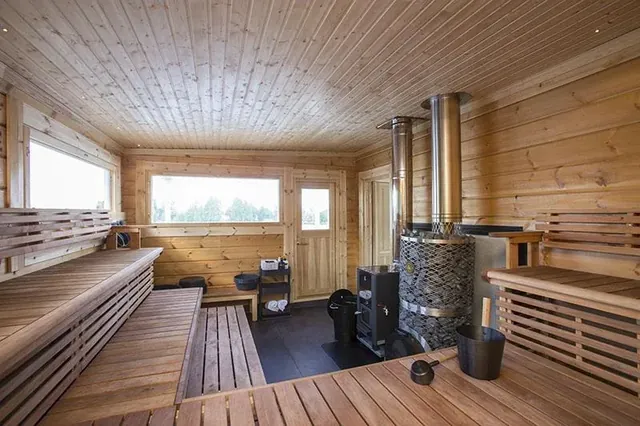
Koivurannan Saunalautta
Oulu · Floating sauna
Frequently asked questions
Is a sauna good for your heart?
In large Finnish studies, people who used a sauna often had fewer deaths from heart disease than people who went once a week. That is a link, not proof.
Can you use a sauna if you have a heart condition?
Many people with stable heart disease can, but some cannot. Unstable angina, a recent heart attack and severe aortic stenosis are reasons not to. Ask your cardiologist first.
How much does a sauna raise your heart rate?
Quite a lot. In one Finnish lab study, heart rate rose by about 60% at 80 °C. The rise depends on the heat and how long you stay.
Does a sauna lower blood pressure?
For a while, yes. In a 2018 study, blood pressure was about 7 mmHg lower after a 30-minute session. Long-term studies link regular sauna use to a lower risk of high blood pressure.
What is Waon therapy?
A mild heat treatment developed in Japan for heart failure. Patients sit in a 60 °C dry sauna for 15 minutes, then rest under a blanket for 30 minutes, under medical supervision.